 Grand Plaza, 2nd floor, Wireless, Moghbazar, Dhaka-1217

- Home
- About Bangladesh
- History of Bangladesh
ইতিহাস, Bangla for History
History of Bangladesh
How ancient Bengal became the independent country of today
History of Bangladesh
Bangladesh, in full the People's Republic of Bangladesh, is an independent country in South Asia. It covers the eastern part of Bengal, the larger share of the region where Bengali is spoken. The country lies at the head of the Bay of Bengal. India and Myanmar are its neighbours, and only the narrow Siliguri Corridor separates it from Nepal and Bhutan.
The Bangladesh we know today became a sovereign state in 1971, when it won independence from Pakistan in the Liberation War. In earlier centuries the region saw local conflicts, the rule of one Indian empire after another, and a long contest for influence between Buddhism and Hinduism.
The country's present borders date from the partition of India and Bengal in August 1947. Along the Radcliffe Line, the area became East Pakistan, one part of the new State of Pakistan.
At first the name was written as two words, Bangla Desh. Bangla refers both to the Bengali language and to the land of Bengal, although nobody knows for certain where the word comes from. Some of the main events in the country's history are outlined below.
The Road to Independence
- 1971
Bangladesh War of Independence
The flag of Bangladesh was flown across the country on 23 March 1971. On the night of 25 March 1971 the military rulers of Pakistan began Operation Searchlight, and in the genocide that followed, Bengali politicians, students, intellectuals, civil servants and soldiers who had changed sides were killed.
The people of Bengal declared independence and formed the Mukti Bahini, the national liberation army of Bangladesh. Throughout the war it controlled much of the countryside and fought a guerrilla campaign against Pakistani forces.
India gave the Mukti Bahini its backing, and both the United States and the Soviet Union sent warships to the Bay of Bengal. After nine months the war ended on 16 December 1971, when the Pakistani army surrendered to the joint forces of Bangladesh and India.
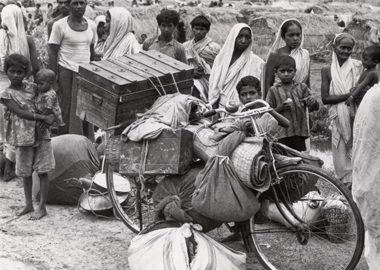
The Liberation War of Bangladesh - 1971 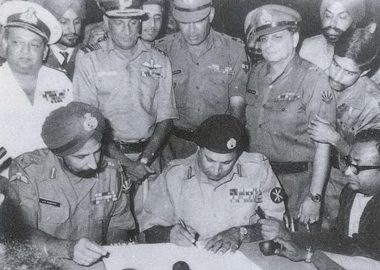
Signing of Independence - 1971 - 1971
Refugee Crisis of 1971
The Liberation War drove people from their homes on an enormous scale. Millions crossed into India to get away from the killing carried out by the Pakistani military, and the refugee camps came to stand for the human cost of the war. The help India gave to the refugees and to the Mukti Bahini was vital to the victory and independence that followed.
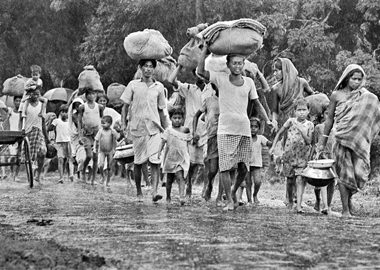
Refugees during the Liberation War - 1971 - 1971-1975
Independence & the Early Years
Once independent, Bangladesh became a secular democracy and a republic within the Commonwealth. It joined the Non-Aligned Movement in 1973, and the OIC and the United Nations in 1974.
In 1974 Bangladesh, India and Pakistan signed a three-way agreement aimed at peace and stability in the subcontinent. The government of the time was led by Sheikh Mujibur Rahman, who was assassinated along with most of his family on 15 August 1975. Two army uprisings later that year reshaped the way the country was governed.
Political Era & Leadership
- 1977-1981
Ziaur Rahman Era
Lieutenant General Ziaur Rahman became president in 1977. By 1979 he had brought back civilian rule and multi-party politics. He founded the Bangladesh Nationalist Party, encouraged free markets and redirected foreign policy towards closer relations with the West. He was assassinated by army officers in 1981.
- 1982-1990
Hussain Muhammad Ershad Era
Lieutenant General Hussain Muhammad Ershad reformed the administration, with a programme of devolution that divided the country into 64 districts and 5 divisions. In 1985 he hosted the first summit of SAARC in Dhaka, which brought seven South Asian countries together in a regional body. He also added to the road network and started major projects such as the Jamuna Bridge.
- 1991-1996, 2001-2006
Khaleda Zia Era
In 1991 Khaleda Zia, a former first lady and leader of the Bangladesh Nationalist Party (BNP), was elected the country's first woman prime minister. The BNP's last term ended in October 2006, and a caretaker government took over to prepare for elections.
- 1996-2001, 2009-2024
Sheikh Hasina Era
In 1996 the Awami League, led by Sheikh Hasina, returned to office after 21 years. In 1998 she hosted a three-way summit of Bangladesh, India and Pakistan, and Bangladesh was a founding member of the D-8 group alongside Turkey. The Awami League won the general election of 2008 and stayed in power until August 2024, when Sheikh Hasina resigned after weeks of student-led protests.
- 2024-Present
A New Chapter
An interim government headed by the Nobel Peace Prize winner Muhammad Yunus took office in August 2024. It oversaw a general election on 12 February 2026, which the BNP won, and Tarique Rahman was sworn in as prime minister on 17 February 2026.
Modern Bangladesh: Progress & Challenges
Economic Progress
Bangladesh has cut poverty dramatically, from about 57% of the population in the early 1990s to 18.7% in 2022. Income per head has grown strongly, and the country has made real gains in human development.
Remaining Challenges
Even so, Bangladesh still has to contend with climate change, inequality, religious extremism and political instability.
Planning a trip?
Tell us what you would like to see and what you want to spend, and we will plan the trip around you.